A fashion shopper decides whether to trust a brand before they scroll past the first product card. That is why fashion brands choose Shopify more than any other platform, and the most ambitious ones go headless. Here is why it happens, when headless actually pays off, and how to avoid overpaying for an architecture you do not need yet.
Why fashion brands choose Shopify
The short answer: Shopify takes the heavy lifting of online retail off the brand — checkout, payments, hosting, security, and scaling for drops — and leaves the team what matters: image, product, and storytelling. That is why apparel is the platform’s largest category: 27.1% of all live Shopify stores sell apparel (Store Leads, The State of Shopify, November 2026).
The gap is striking next to competitors: 28.2% of Shopify stores sell clothing versus just 9.1% on WooCommerce (Customcy, analysis of 13M stores, 2026). Fashion brands vote with their feet for a few reasons:
- •Variants and collections. Sizes, colors, capsules, and seasonal drops are core features, not add-ons.
- •International selling. Multiple languages, currencies, and local payment methods in one admin.
- •Traffic without risk. A drop or a sale will not take the site down, because Shopify runs the infrastructure.
- •A flexible front end. From a custom theme to a fully bespoke Hydrogen storefront — without changing platforms.
What headless Shopify means for a fashion brand
Headless Shopify means the storefront shoppers see is built separately from the commerce engine. Shopify still runs the catalog, cart, checkout, and orders, while the front end is built with Hydrogen (Shopify’s framework) and hosted on Oxygen, Shopify’s global hosting. The brand gets full design freedom instead of template limits.
The co-founder of Canadian fashion brand Kotn put it well:
“Shopify covers 80% of our needs, and I think that’s common across all merchants. It’s that next 20% where headless comes in and where we really spend our time.”
— Benjamin Sehl, co-founder of Kotn (Shopify Enterprise Blog, 2026).
The 3 pillars of a fashion store on Shopify
The most common mistake is framing the choice as “theme or headless.” In reality, a fashion store on Shopify rests on 3 pillars: a custom theme, an international theme, and headless. Each solves its own class of problems, and you should move to the next one only when your current setup starts holding the brand back.
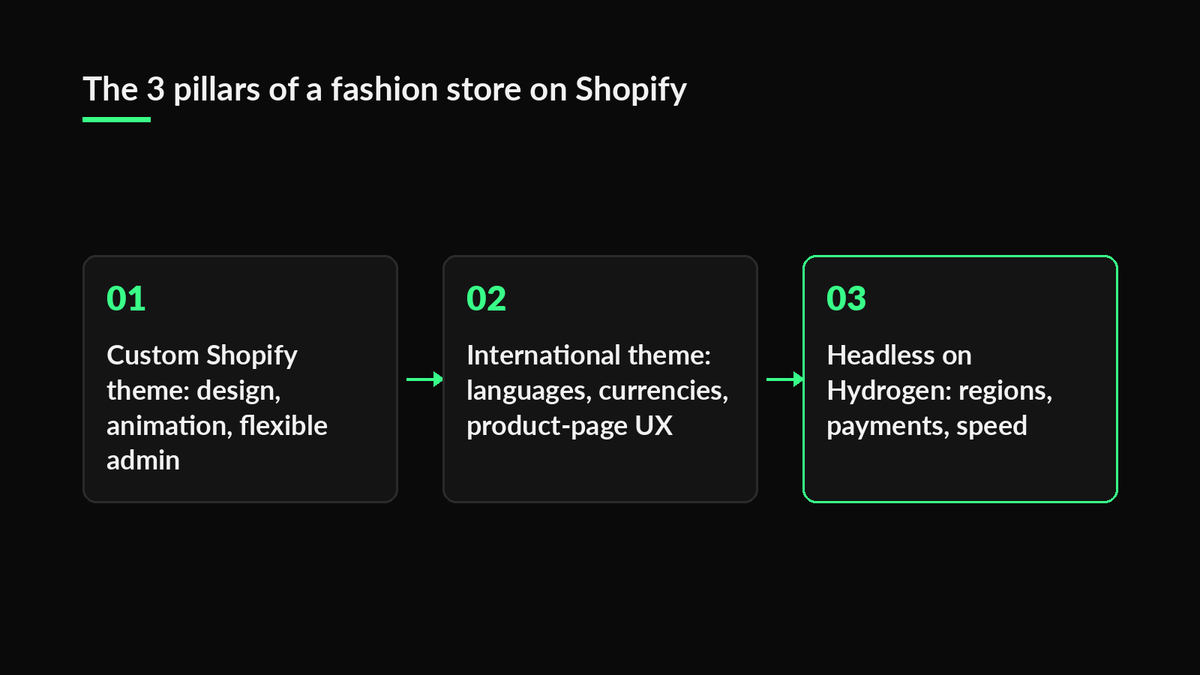
Pillar 1. A custom Shopify theme
This is enough for most brands: a distinctive design on a theme, a flexible admin, and animations that carry the character of the collection. The team updates the homepage, banners, and lookbooks without waiting for a developer.
WSS case in point: Ruslan Baginskiy — a homepage redesign for the Ukrainian headwear brand’s Shopify store. We built several popup types (including an interactive monogram button that expands into backstage video), separate menu layouts for desktop and mobile, and an extended admin where the team adjusts blocks and font sizes and duplicates sections on their own.
Pillar 2. An international theme with considered UX
Once a brand goes global, the theme has to work like a product: languages, currencies, a smooth product page, and tools that remove sizing doubts. It is still a Shopify theme, just with deeper customization and metafields.
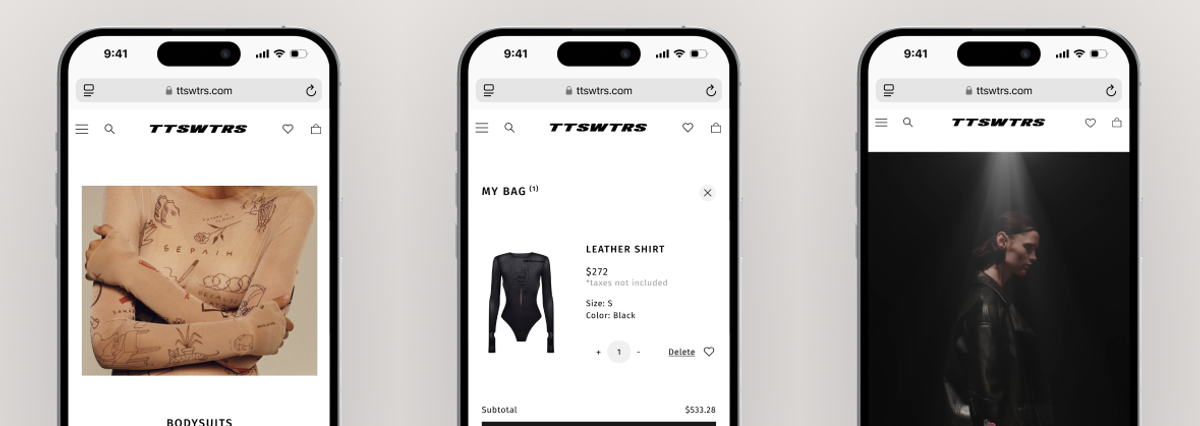
WSS case in point: TTSWTRS — a store redesign for a global brand with an international English version supporting multiple languages and currencies. We built smooth scrolling inside the product page, integrated a virtual fitting room button, and moved part of the product data into metafields to simplify content entry.
Pillar 3. Headless on Hydrogen and Oxygen
Headless makes sense when a brand sells across regions with different payments and logistics, and speed and a non-standard interface become a competitive edge. SKIMS, Kotn, and Denim Tears work this way, and Paris label Nour Hammour reported +63% conversion and +128% sales year over year after launching on Hydrogen (Shopify Enterprise Blog, 2026).
WSS case in point: Zhilyova — ongoing support and development of a Shopify Headless store (Remix, TypeScript, Hydrogen, Oxygen). We launched regional versions with local payment systems, integrated Baselinker for delivery across Europe, optimized scripts and homepage speed, and set up metafield content through Airtable. The store reliably serves shoppers in Ukraine, Europe, and the US.
When headless is the wrong call for a fashion brand
Headless does not make a site faster by itself. In a study of 249 stores that moved from WooCommerce, Magento, or Shopify to a Next.js front end, the share passing Core Web Vitals fell from 34.7% to 19.0% (PageSpeed Matters, 2026). Speed comes from build quality, not architecture. Thats why all project, that we develop must pass all our internal Q&A processes.
Shopify itself advises patience: its guide says small and midsize businesses can deliver distinctive brand experiences on themes, while headless suits teams with in-house developers and budgets of $1M or more (Shopify, 2026, via Deploi). For the full math, see our breakdown Headless Shopify in 2027: when it pays off.
But if speed is your bottleneck, it pays: a mobile site just 0.1 seconds faster lifted retail conversion by 8.4%, and in luxury it lifted product-page-to-basket progression by 40.1% (Deloitte, “Milliseconds Make Millions,” 2020).
Which pillar your store needs: three questions
- 1.Does your theme get in the way of brand storytelling? If lookbooks, video, and animation fit inside a theme, pillar 1 is enough.
- 2.How many markets and payment scenarios? One or two countries — a theme with Shopify Markets. Several regions with different logistics and payments — time to look at headless.
- 3.Who will maintain the front end? Headless needs an ongoing development team. No team, no point in headless.
FAQ
We work with brands that already lead their industry and with brands determined to get there — and we genuinely love helping them grow. The Web-Systems Solutions team builds Shopify stores both on themes and custom design, and also headless storefronts for fashion brands and can tell you which of the 3 pillars your store needs right now. Email info@web-systems.solutions or call +38 (067) 980-09-00.